
Table of Contents
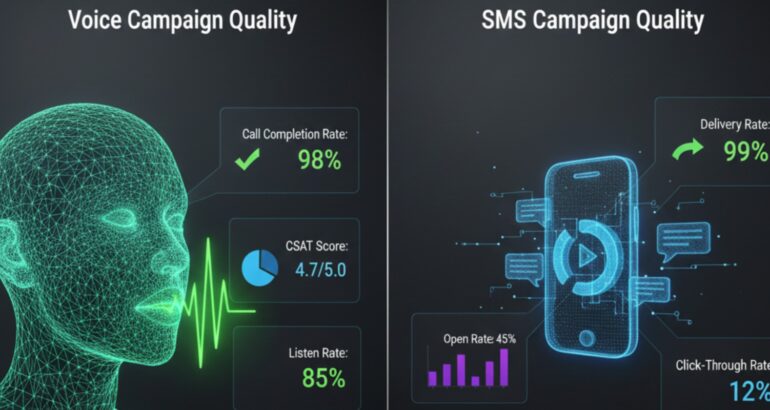
Voice calls and SMS messages are still two of the strongest ways businesses talk to customers. They are fast, direct, and personal. But running voice and SMS campaigns is not just about sending messages. It is about sending the right message, at the right time, in the right way.
Many businesses spend money on campaigns but do not track quality. This leads to wasted budget, unhappy customers, and poor results. Quality control helps you understand what is working and what is not. It shows where calls fail, why messages are ignored, and how customers really respond.
In this blog, we explain quality control in voice and SMS campaigns in very simple words. We also share the most important metrics that truly matter.
What Is Quality Control in Voice and SMS Campaigns?
Quality control means checking how good your voice calls and SMS messages are. It is not only about delivery. It is about experience.
For voice campaigns, quality control checks call clarity, call flow, connection success, and agent behavior. For SMS campaigns, it checks delivery, timing, message clarity, and customer response.
Without quality control, campaigns may look active but fail silently.
Why Quality Control Is Important
Poor quality campaigns cause big problems:
- Customers hang up quickly
- Messages get ignored or blocked
- Telecom costs increase
- Brand trust goes down
Good quality control helps businesses:
- Save money
- Improve customer trust
- Increase response rates
- Fix issues early
Now let us look at the most important metrics.
Call Answer Rate: Are People Picking Up?
Call answer rate shows how many people actually answer your calls. If you dial 1,000 numbers and only 200 people answer, your answer rate is 20%.
A low answer rate means:
- Wrong calling time
- Poor number quality
- Customers do not trust the caller
Improving this metric helps you reach more people without increasing call volume.
Call Drop Rate: Are Calls Ending Too Early?
Call drop rate shows how many calls end suddenly. This can happen because of network issues, poor routing, or system problems.
High call drop rate creates frustration. Customers may feel the call was fake or unsafe. Businesses also lose money because they pay for failed calls.
A good system keeps call drops very low.
Average Call Duration: Are Conversations Meaningful?
Average call duration tells how long calls last. Very short calls usually mean customers are hanging up early. Very long calls may mean agents are struggling.
Healthy call duration shows:
- Clear voice quality
- Easy conversation flow
- Proper call purpose
This metric helps balance quality and efficiency.
First Call Resolution: Is the Problem Solved in One Call?
First call resolution means the customer’s issue is solved in the first call itself.
Low first call resolution causes:
- Repeat calls
- Higher call costs
- Angry customers
High first call resolution means better scripts, trained agents, and clear communication.
SMS Delivery Rate: Are Messages Reaching Customers?
SMS delivery rate shows how many messages successfully reach phones.
Low delivery rate can happen due to:
- Invalid numbers
- Spam filtering
- Poor sender reputation
Good delivery rate ensures your message is actually seen.
SMS Open Rate: Are Messages Being Read?
Most SMS messages are opened within minutes, but not all.
Low open rates mean:
- Message sent at wrong time
- Unclear sender name
- Message looks unimportant
Clear sender IDs and simple language improve this metric.
Response Rate: Are Customers Replying?
Response rate measures how many customers reply to your SMS or voice prompt.
This is one of the most important metrics because it shows real interest.
Low response rate means:
- Message is confusing
- No clear action mentioned
- Customer does not trust the sender
Clear calls-to-action improve response.
Opt-Out Rate: Are Customers Saying Stop?
Opt-out rate shows how many people unsubscribe from your SMS or block your calls.
High opt-out rate is a warning sign. It means customers feel annoyed or disturbed.
Quality campaigns keep opt-out rates low by:
- Sending fewer messages
- Keeping content helpful
- Respecting customer time
Voice Quality Score: Is the Call Clear?
Voice quality score checks how clear and stable the call sounds.
Poor voice quality leads to:
- Misunderstanding
- Call hang-ups
- Loss of trust
Good quality systems use strong networks and smart routing.
Campaign Timing Performance: Are You Calling at the Right Time?
Timing matters more than many people think.
Calling or messaging at the wrong time leads to low answers and high opt-outs.
Tracking timing performance helps you learn:
- Best call hours
- Best SMS delivery time
- Day-wise success patterns
This improves results without extra cost.
Compliance Score: Are You Following Rules?
Compliance is part of quality control.
This includes:
- Do-not-disturb rules
- Opt-in consent
- Approved message content
Ignoring compliance leads to penalties and blocked routes. Quality systems track this automatically.
How Quality Control Improves Campaign Results
When businesses track the right metrics, results improve naturally.
- Call costs go down
- Response rates go up
- Customer trust improves
- Campaign planning becomes easier
Quality control turns random campaigns into smart campaigns.
Simple Tools Make Quality Control Easy
Modern voice and SMS platforms provide dashboards that show all these metrics in real time.
Businesses do not need technical knowledge. They just need to watch trends and take action.
Predictive dialing, smart routing, and real-time reports make quality control simple.
Quality control is not optional in voice and SMS campaigns. It is the foundation of success.
Sending more messages does not mean better results. Sending better quality messages does.
By tracking key metrics like answer rate, delivery rate, response rate, call quality, and opt-outs, businesses protect their brand and budget at the same time.
When quality comes first, customers listen, respond, and trust you more. And that is what truly makes a campaign successful.